


Dampening Interior Noise Enhances Work, Privacy And Productivity
November 18, 2015
When designing for new construction or renovating an existing facility, consider opportunities for dampening noise that occurs both between and within spaces along with noise from infrastructure systems such as HVAC, elevators and generators.
The Basics For Controlling Noise Between Spaces
Well insulated wall and floor systems can do more than subdivide space, provide energy savings and act as a fire retardant. Opportunities for sound dampening exist within interior stud cavities, between floor joists, over ceiling panels and around partitions, doors, windows and ducting.
The measure of an insulating product’s attenuating ability is represented by STC [sound transmission coefficient]. Higher STC values are more acoustically efficient. For example, loud speech cannot be well understood through a wall system with an STC of 60 or higher. Acoustical planning should account for the STC of an entire system, not only its individual wall and floor components.
- Metal studs perform acoustically better than wood studs.
- Extend a wall to its structural deck rather than only to a dropped ceiling to contain noise in cavities above ceilings.
- Decouple ceiling and framing by staggering wall studs and separating the two sides of a wall by using thicker insulation and gypsum board together.
- Increase the size of air cavities between walls and floors and within window assemblies and install sound attenuation insulation batts.
- High airflow resistivity insulation delivers better sound attenuation compared to fiberglass for low frequency noise such as conversation, audio-visual equipment and ventilation systems.
- Rubberized, flexible acoustical sound barrier sheets that are nailed directly to studs or floor joists reduce sound transmission through walls and floors.
- Elastomeric foam HVAC duct insulation dampens low frequency noise.
The Basics For Controlling Noise Within A Space
“Reflections” caused by the shape of an enclosed space and the material on its surfaces generate reverberation noise within that space.
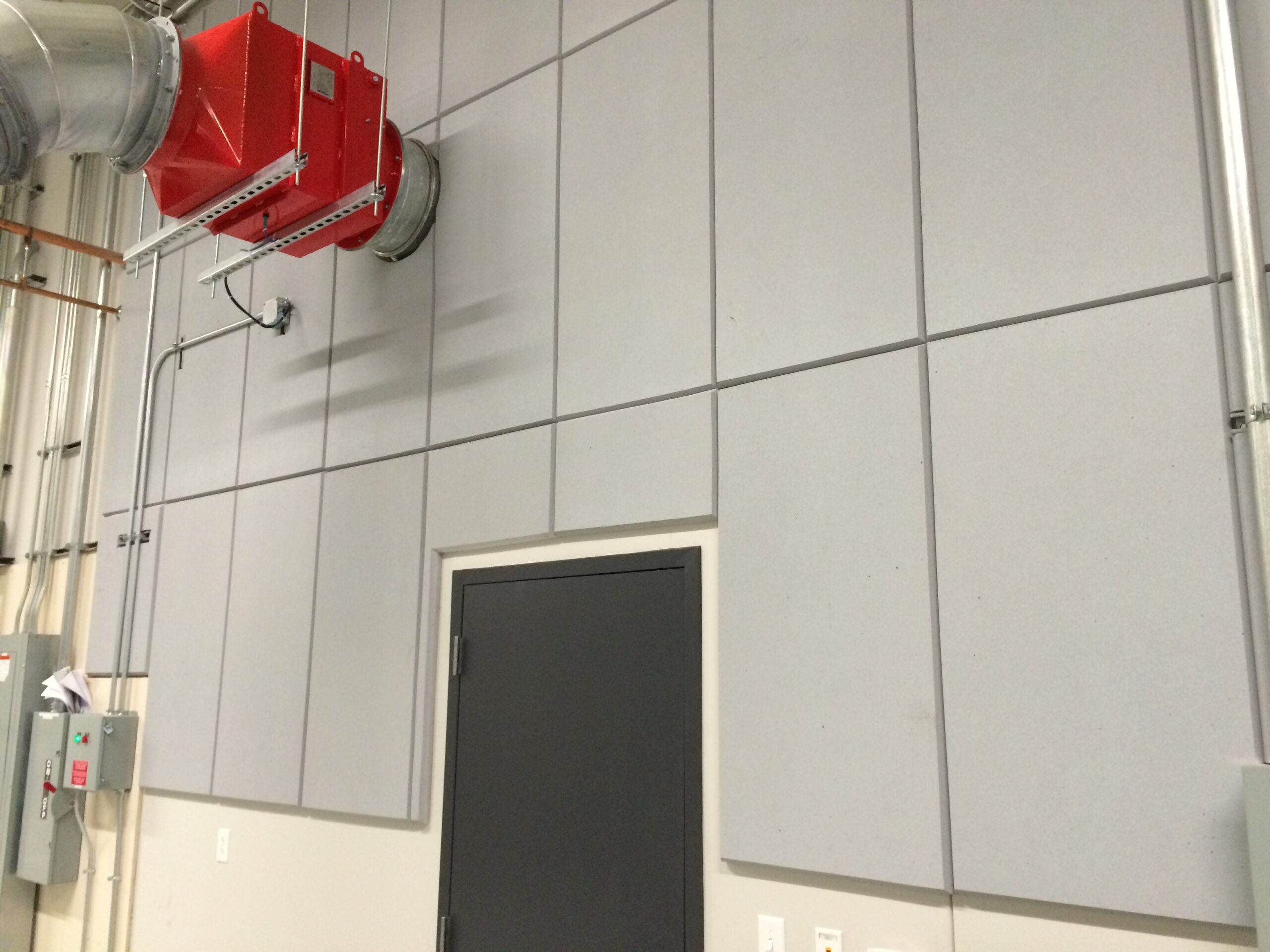
- Absorptive surface treatments minimize reflection problems. Their NRC [Noise Reduction Coefficient] can be as high as 50% attenuation and four times more absorptive than carpet.
- Effective acoustical design will minimize the megaphone effect from reflective corners and peaked ceilings; sound “fluttering” between reflective parallel surfaces; and focused reflections [rather than dispersed] caused by domes and concave surfaces.
Being aware that there are ways to control noise within and between spaces is your first step to ensuring that work, privacy and productivity are the beneficiaries of whatever acoustical solutions you choose.
Always hire a builder that has a specialist on staff or a partner who can assess your particular acoustical situation, design solutions, recommend the right products, and participate in their installation.
-
- Absorptive surface treatments minimize reflection problems.
-
- Acoustical sound barrier sheets reduce sound transmission through walls and floors.
-
- Sound barriers dampen low frequency noise.
Recent News

How to Compare Construction Proposals: Why the Lowest Bid Might Not Tell the Whole Story
September 29, 2026

Construction Manager vs. General Contractor: What’s the Difference?
August 18, 2026
Commercial Construction Services Across Connecticut, Rhode Island, Massachusetts & New York
August 7, 2026
Top 5 Manufacturing Facility Upgrades That Improve Efficiency and Support Growth
July 23, 2026
Pre-Engineered Metal Buildings: The Smart Choice for Modern Commercial Construction in Connecticut
July 16, 2026
The Hidden Costs of Deferred Maintenance: How a $500 Repair Can Become a $50,000 Project
July 15, 2026

Munger Construction Named to Metal Construction News Top 100 Metal Builders List for 2026
May 5, 2026